Tailored Fibre Placement (TFP)

Tailored Fibre Placement (TFP): Precision Reinforcement for Next-Gen Composites

At Carbon ThreeSixty, we move beyond the limitations of traditional fabric architectures. Our Tailored Fibre Placement (TFP) capability allows us to engineer performance exactly where it’s needed, reducing waste and optimising weight for the most demanding aerospace, automotive, and defense applications. products are made possible by using netting techniques to drape and form from 2D to 3D.

Having this capability enables Carbon ThreeSixty to design and build our own product specific preforms and fabrics on site in a matter of minutes.

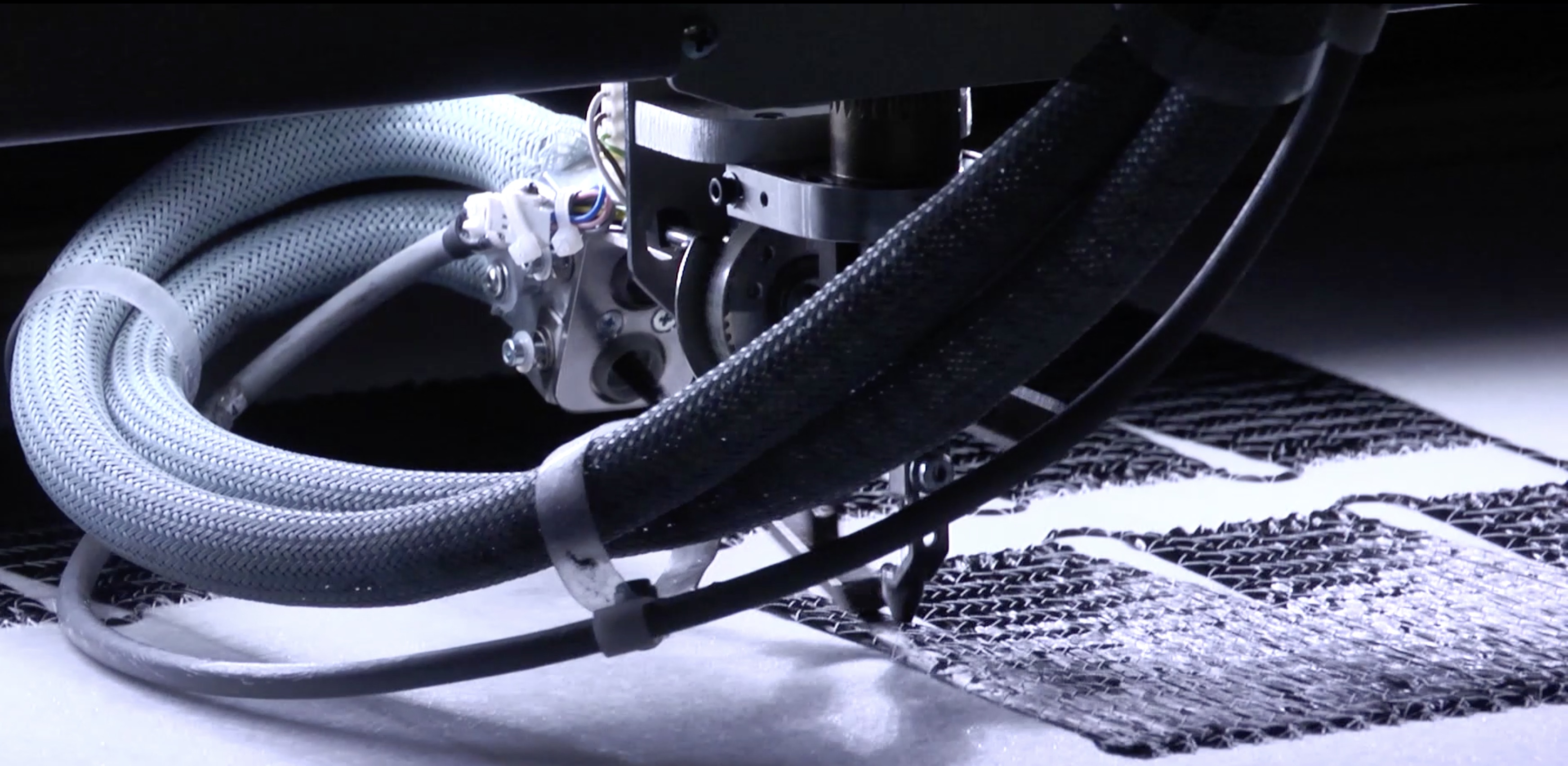
Utilising automated processes also enables the scale up of future, high volume production.

TFP Dark

What is Tailored Fibre Placement?

Tailored Fibre Placement is an advanced automated preforming technology that uses a CNC-controlled stitching process to secure carbon, glass, or aramid fibres onto a base material. Unlike standard woven fabrics, TFP allows for curvilinear fibre paths, meaning we can align fibres precisely with the principal stress vectors of your component.

Why Choose TFP for Your Project?

  • Optimised Strength-to-Weight: By placing fibres only where the load paths require them, we eliminate redundant material, creating parts that are lighter yet stronger than traditional laminates.
  • Significant Waste Reduction: Traditional “buy-to-fly” ratios are high due to ply cutting. TFP is a “near-net-shape” process, reducing material scrap to near zero.
  • Complex Geometry: We can create complex, multi-directional reinforcements and integrated inserts that are impossible to achieve with standard CNC ply cutting and manual layup.
  • Repeatability & Scalability: Our automated CNC stitching ensures every preform is identical, providing the high-level consistency required for serial production.
CTS TFP Cell Iss 1 20200123

Integration

Our TFP process isn’t just about placing dry fibres; it’s about creating a production-ready preform. We seamlessly integrate TFP into various manufacturing routes, including:

  1. Resin Transfer Moulding (RTM): Combining TFP preforms with RTM for aerospace-grade finishes.
  2. Vacuum Infusion: Ideal for larger structural components where localised reinforcement is critical.
  3. Hybrid Materials: The ability to mix fibre types (e.g., Carbon and Thermoplastic) within a single preform for specific damping or thermal properties.

Applications of TFP

From localised reinforcement around bolt holes to complex 3D structural nodes, Carbon ThreeSixty utilises TFP to solve engineering challenges across industries:

  • Aerospace: High-stiffness brackets, engine components and drones.
  • Automotive: Crash structures, lightweight EV battery enclosures and wheels.
  • Industrial: High-speed rotating equipment where centrifugal forces require specific radial reinforcement.
TFP Stitching