Filament Winding

Filament Winding at Carbon ThreeSixty

Filament Winding at Carbon ThreeSixty, we specialise in the design and manufacture of high-performance composite structures. Central to our technical capability is Filament Winding, a precise, automated process used to create high-strength, lightweight cylindrical and spherical components for the most demanding aerospace, defence, and automotive applications.

What is Filament Winding?

Filament winding is an additive manufacturing technique for composites. It involves winding continuous fibres—typically carbon fibre, glass fibre, or aramids—under controlled tension over a rotating mandrel.

The fibres are either pre-impregnated with resin (Pre-preg or Tow-preg) or passed through a resin bath (Wet Winding) immediately before they reach the mandrel. Once the winding is complete, the part is cured in an oven or autoclave, and the mandrel is removed, leaving a hollow composite structure.

The Process at a Glance

  1. Mandrel Preparation: A precision-engineered mould (the mandrel) is prepared to define the internal geometry.
  2. Fibre Delivery: Carbon fibre tows are fed from a creel system through a delivery head.
  3. Tension & Placement: Computer-controlled axes ensure the fibre is placed at exact angles to meet structural requirements.
  4. Curing: The component is heat-cured to solidify the resin matrix.
  5. Extraction: The mandrel is removed, resulting in a finished composite part.
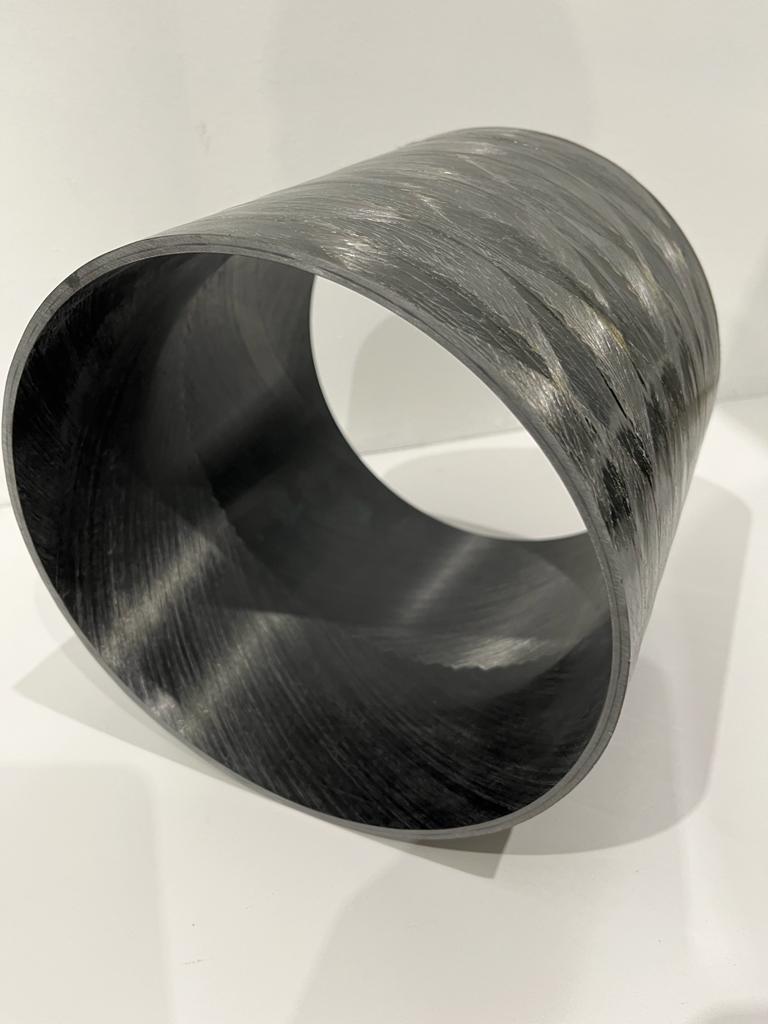
Filament Wound Pattern

Why Carbon ThreeSixty?

We don’t just “wind” fibre; we engineer solutions. Our approach to Filament Winding at Carbon ThreeSixty is to integrate advanced materials science with state-of-the-art automation.

1. Multi-Axis Precision

Our robotic and CNC winding cells allow for complex fibre architectures. By varying the winding angle, we can tailor the mechanical properties of the component:

  • Circumferential (Hoop) Winding: Provides maximum resistance to internal pressure (ideal for pressure vessels).
  • Helical Winding: Optimised for longitudinal strength and torsional rigidity (ideal for drive shafts). 
  • O Degree fibre:  Through the use of pin arrays, we can add axial fibres to structures for maximum bending performance.

2. Specialised Core Competencies

  • Drive Shafts & Struts: Leveraging high-modulus carbon fibre to reduce rotating mass and improve NVH (Noise, Vibration, and Harshness) levels in automotive applications.
  • Integrated Bosses & Fittings: Our process allows for the seamless integration of metallic end-fittings during the winding phase.
  • Composite Pressure Vessels (CPVs): We produce COPVs (Composite Overwrapped Pressure Vessels) that are significantly lighter than traditional steel or aluminum equivalents.
Filament winding 1